
Equipment Safety
Tractor and Trailer Matching: Load, Brakes and Safe Use
Tractorbandhu Editorial · 29 October 2026
Check permitted weights, hitch and brake compatibility, load security and route conditions before putting a tractor-trailer combination to work.
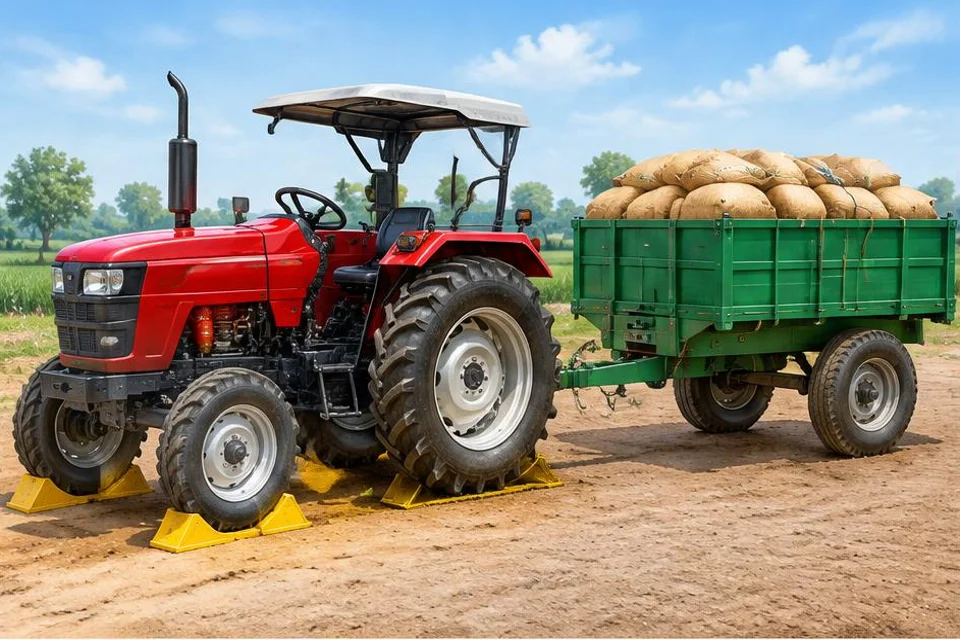
AI-generated illustration · Not a specific model photograph
1. Begin with permitted weights
A tractor's ability to move a trailer does not prove that the combination can steer, stop or remain stable safely. Obtain the tractor's towing and hitch limits and the trailer's rated weights from the exact documents or manufacturer. Include the trailer's own weight when assessing total mass. Engine horsepower alone cannot determine a safe payload.
- Ask a qualified dealer to explain every applicable limit for the proposed combination.
2. Verify hitch and braking compatibility
Have competent personnel confirm the approved coupling arrangement and the compatibility and condition of the braking system. HSE guidance emphasises trailer brakes suitable for maximum operating loads and speeds. Do not assume tractor brakes alone are adequate for an arbitrary trailer. Attachment, testing and adjustment must follow the exact manuals; improvised coupling changes are not an acceptable shortcut.
- Resolve missing specifications or brake defects before loading or travelling.
3. Match the load to the trailer
Consider material density, load distribution, secure containment and the trailer manufacturer's instructions. A visually similar volume can represent very different weights. Check tyres, wheels, axles, body condition and any tipping system through a competent inspection. Do not add extensions simply to carry more. Keep people out of the trailer body and away from loading and tipping zones.
- Use a reliable weight check when the load cannot be established confidently.
4. Assess the route and unloading site
Review slopes, soft ground, narrow entrances, sharp turns, visibility and pedestrian movement. Confirm lighting, reflectors and road-use documentation with the relevant Indian authorities for your location and use. Plan unloading on a suitable site, accounting for overhead hazards and the exact tipping instructions. Overseas safety guidance is useful, but it does not replace Indian legal requirements.
- Do not treat an empty-trailer journey as proof that a loaded route is safe.
5. Maintain the combination and train operators
Use trained drivers and arrange pre-use checks, prompt defect reporting and scheduled maintenance, especially for brakes. Keep loads stable and secure, and exclude unauthorised passengers. Before leaving the operating position or allowing inspection, apply the manual's safe stopping and isolation procedure. Never work beneath a raised body without its prescribed secure support and qualified supervision.
- Keep inspection and repair records with the tractor and trailer identification details.