
Buying Advice
Tractor Clutch Types: Ask How Travel and PTO Actually Work
Tractorbandhu Editorial · 29 October 2026
Move beyond clutch labels and verify what happens to tractor movement and implement power during normal operation.
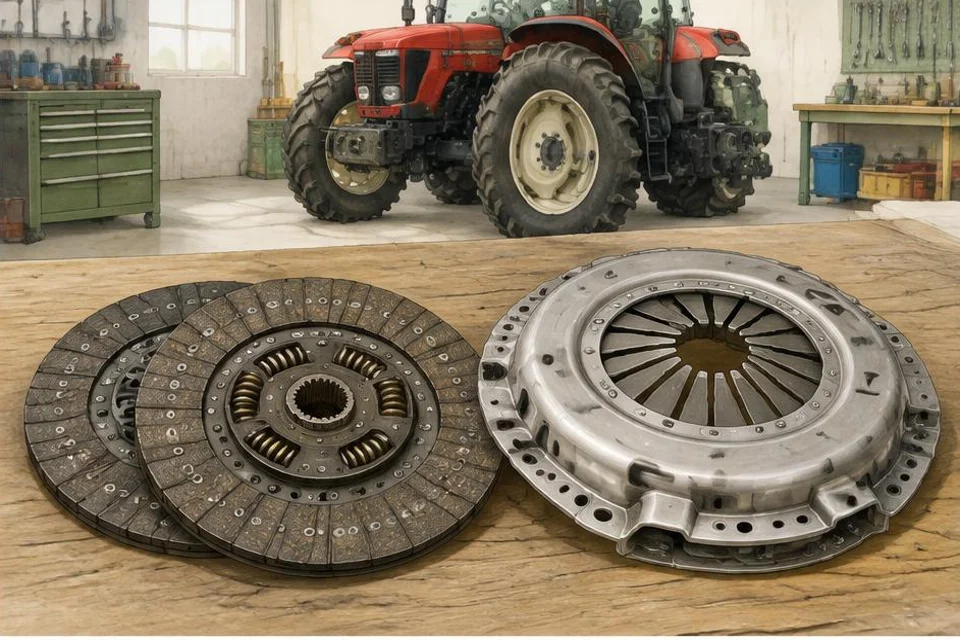
AI-generated illustration · Not a specific model photograph
1. Begin with the job that causes interruptions
A clutch choice matters most when your work repeatedly separates tractor movement from implement operation. List tasks such as turning with a PTO-driven implement, loader manoeuvring or frequent transport starts. Ask the dealer to explain the exact model's controls rather than ranking single, dual or independent systems by name alone. The complete transmission and PTO arrangement determines how the tractor behaves.
- Bring the implement's operating requirements to the discussion.
2. Clarify what a single-clutch arrangement controls
In a typical transmission-driven PTO arrangement, disengaging the main clutch interrupts drive to both the transmission and PTO. However, a 'single clutch' specification alone does not describe every possible PTO configuration. Ask what happens when the pedal is fully pressed, whether the implement keeps receiving power and which stopping procedure applies. Verify the answer in the exact operator manual, not only a brochure.
- Ask separately about stopping travel and stopping the implement.
3. Understand two-stage and separate controls
A common two-stage clutch allows an initial pedal stage to interrupt travel while a further stage disengages PTO drive. Adjustment and operating instructions are model-specific. Independent PTO generally uses a separate control so engagement is not tied directly to the travel clutch. Terms such as dual and double are not always used consistently across brands, so request a control-by-control explanation.
- Confirm whether PTO engagement is permitted under the conditions your task requires.
4. Request a safe demonstration of everyday use
Have a trained demonstrator show pedal effort, travel control and PTO controls in an appropriate clear area. Compare repeated starts, reversing and implement control without standing near shafts or moving equipment. PTO disengagement does not mean an implement stops instantly; stored motion can remain. Keep guards fitted and never approach rotating machinery. Do not let anyone bypass interlocks to make a demonstration easier.
- Judge whether every regular operator can use the controls comfortably and correctly.
5. Ask about care and repair responsibilities
Ask which pedal checks or free-play checks the owner must perform and which adjustments require a qualified technician. Follow the exact manual; an invented adjustment can cause poor disengagement or accelerated wear. Discuss parts availability, service access and written warranty terms without assuming clutch friction parts have blanket coverage. Choose the arrangement that fits your tasks and operators, not a promise that one clutch type never wears out.
- Avoid habitual clutch slipping to compensate for an unsuitable working gear.