
Buying Guide
How to Choose the Right Tractor for Your Farm
Tractorbandhu Editorial · 29 October 2026
Choose by jobs, implement compatibility, access, service and total ownership cost—not horsepower alone.
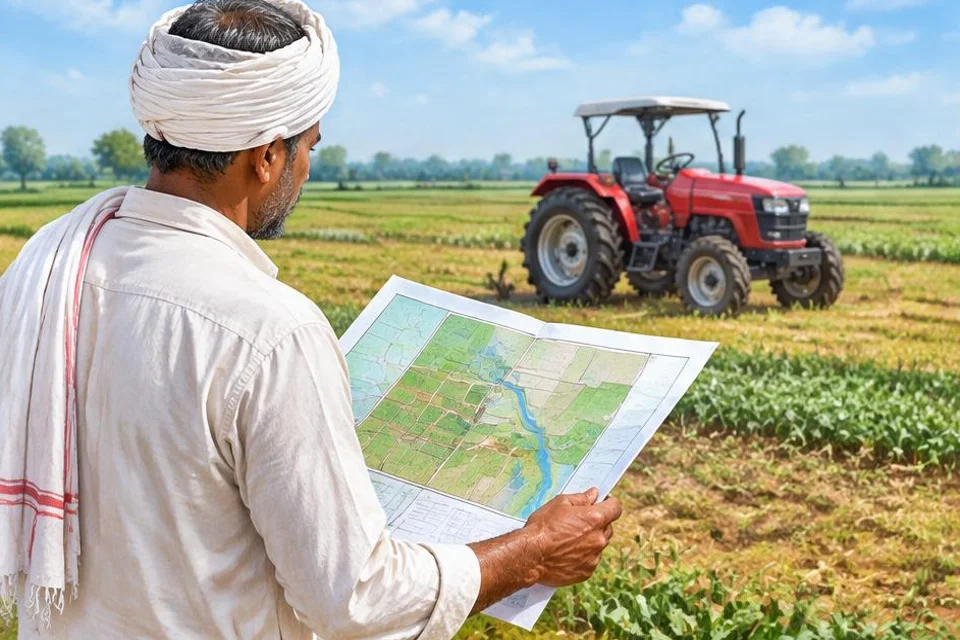
AI-generated illustration · Not a specific model photograph
1. Make a work calendar before a shortlist
By Tractorbandhu Editorial. Start with the jobs your tractor must finish, rather than a favourite badge or a neighbour’s purchase. Write down land preparation, sowing, spraying, harvesting support and transport separately. For each, record soil condition, working depth, available days and expected operating hours. Include scattered plots and travel between them. Farm area matters, but it cannot produce a reliable acreage-to-horsepower rule: the same area can require very different equipment and working time under different crops, soils and weather windows.
2. Let the implements set the requirements
Mahindra’s implement-selection guide stresses that attachments are not universally compatible. For every existing or planned implement, obtain its recommended tractor power range, PTO requirement, operating speed, weight and hitch category. Ask whether external hydraulic connections are needed. Compare those requirements with the exact tractor variant, not a family advertisement. A tractor that can lift an attachment may still lack the PTO power to run it properly. Conversely, adequate engine power does not establish that the hitch, hydraulics or attachment geometry will fit safely.
3. Check the route as well as the field
Measure the narrowest gate, shed entrance, row spacing and headland where the tractor must turn. Compare overall dimensions, tyre options and turning space with these measurements. Walk the route after rain to identify soft patches, drains and unsafe edges. Consider 2WD where firm-ground work predominates; evaluate 4WD where traction repeatedly limits operations. More driven wheels do not remove rollover or braking risks. Ask the dealer to assess approved tyre pressures, ballast and implement suitability instead of improvising extra weight to overcome a mismatch.
4. Test the controls at useful working speeds
The number of gears alone does not tell you whether suitable operating speeds are available. During a dealer-supervised demonstration, check whether the tractor can travel at the implement’s required speed while maintaining the specified PTO setting. Try steering, clutch, brakes, gear selection and hydraulic controls from the normal seat position. Check visibility to the hitch and comfort when looking behind. Ask how the particular clutch and PTO arrangement behaves when stopping forward travel; do not assume different variants operate identically because their model names sound similar.
5. Build a complete ownership budget
Obtain an itemised written quotation covering the tractor variant, tyres, approved accessories, delivery, registration and insurance where applicable. Add implement purchases, scheduled servicing, consumables, storage and a repair reserve. If borrowing, compare down payment, interest calculation, fees, insurance conditions and the full repayment schedule—not just the instalment. Ask the local workshop about parts availability and service turnaround during peak season. Estimate fuel costs from a relevant demonstration or documented operating records, not an unsupported claim that one horsepower class always costs less to run.
6. Finish with a safe acceptance checklist
Before paying the balance, match the invoice, variant, serial numbers and delivered equipment. Collect the operator’s manual, warranty terms and service schedule, and request instruction for the actual tractor and attachments. For any implement inspection or adjustment, park securely, lower equipment safely, disengage and isolate the PTO, stop the engine, remove the key and wait until everything is fully stationary. Keep PTO and driveline shields fitted. Have a trained technician resolve compatibility questions. Choose the machine that meets documented needs within your budget; no specification guarantees farm results.