
Tractor Basics
Engine HP vs PTO HP: What Farmers Should Compare
Tractorbandhu Editorial · 29 October 2026
Learn why engine power and PTO power are different and how to match a tractor safely to powered implements.
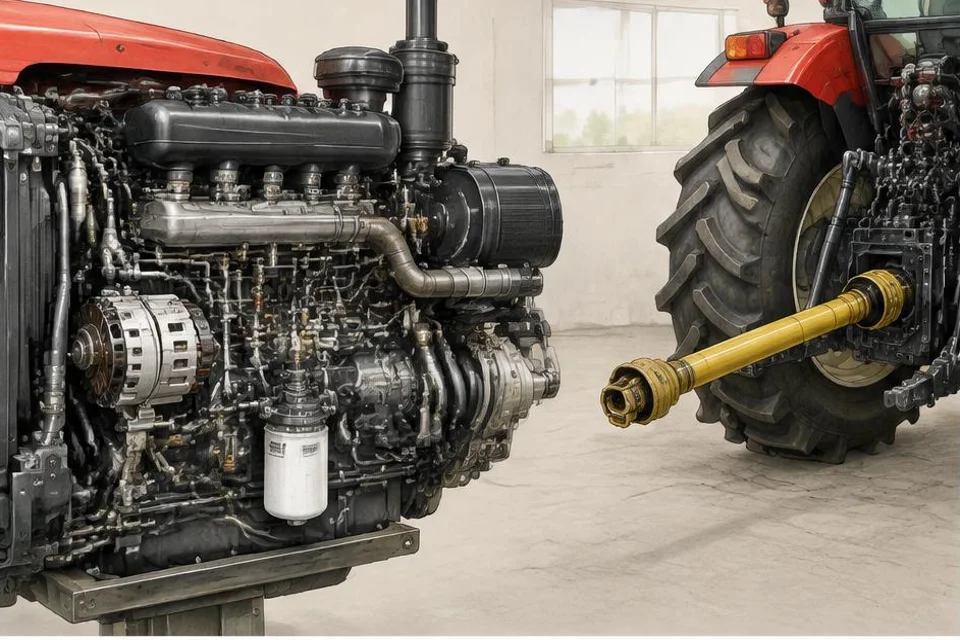
AI-generated illustration · Not a specific model photograph
1. Know where each power figure is measured
By Tractorbandhu Editorial. Engine horsepower describes power rated at the engine under the manufacturer’s stated conditions. PTO horsepower describes power available at the power-take-off shaft to drive compatible equipment. These are different points in the power path, so an engine rating is not a promise of the same output at the implement. Mahindra’s implement-selection guide lists engine power and PTO output separately and stresses matching attachments to available PTO and hydraulic capability. Start comparisons with the exact variant’s published specifications, not only the model’s headline horsepower class.
2. Do not use a fixed conversion percentage
Mechanical transmission losses and the stated rating conditions affect the relationship between engine and PTO output. There is no universal percentage that reliably converts every tractor’s engine HP into PTO HP. Ask the dealer for the manufacturer’s published PTO rating, its rated speed and the relevant brochure or manual. Check that quoted units and measurement descriptions are comparable. If only engine horsepower is available, leave PTO capability unconfirmed until documented. Do not fill a missing specification with a convenient estimate and then use it to justify buying an implement.
3. Separate PTO speed from PTO power
A PTO speed such as 540 rpm describes how fast the shaft turns; it does not state how much power is available. The engine speed needed to obtain that PTO speed depends on the tractor and selected mode. John Deere’s operating manual gives distinct settings for standard and economy PTO on the models it covers, demonstrating why one engine-rpm instruction cannot be applied to all tractors. Use your own tractor and implement manuals. Never assume that operating an attachment faster than its specified shaft speed will improve its performance safely.
4. Match the complete implement requirement
For a rotavator, mower, sprayer or other powered attachment, obtain the recommended PTO power range, required shaft speed and approved tractor fitment. Then check hitch category, implement weight, driveline suitability and hydraulic needs. Adequate PTO horsepower alone does not establish compatibility, and sufficient lift capacity alone does not prove the attachment can be driven correctly. Mahindra’s guide treats these checks as connected requirements. Ask a trained dealer technician to confirm the combination in writing and demonstrate normal operation within manufacturer limits, rather than experimenting with mismatched shafts or improvised connections.
5. Understand economy mode and field behaviour
Where provided, an economy PTO setting can deliver the specified shaft speed at a lower engine speed, but its use must follow the model’s instructions and suit the load. It is not a universal full-power replacement or a guaranteed fuel-saving setting for every attachment. During an authorised demonstration, observe whether the tractor maintains the required operating conditions with the matched implement. If it struggles, stop and have the dealer assess the combination. More engine HP will not solve every issue: working depth, implement selection, maintenance and ground conditions can also affect performance.
6. Put safety ahead of the power comparison
John Deere’s operator manual warns that rotating drivelines can cause severe injury or death and requires tractor PTO and driveline shields. Before connecting, adjusting, inspecting or cleaning equipment, park securely, lower the implement safely, disengage and isolate the PTO, stop the engine, remove the key and wait until all moving parts are fully stationary. Never clear a blockage with the shaft turning or rely on disengagement alone. Have damaged or missing guards corrected before use. Compare documented PTO output for the intended attachment, then verify all other limits before making the purchase.