
Comparisons
Compare Mahindra, Sonalika, John Deere and New Holland: Buyer’s Checklist
Tractorbandhu Editorial · 29 October 2026
Compare exact variants, implement compatibility, local support and written ownership costs without choosing a universal brand winner.
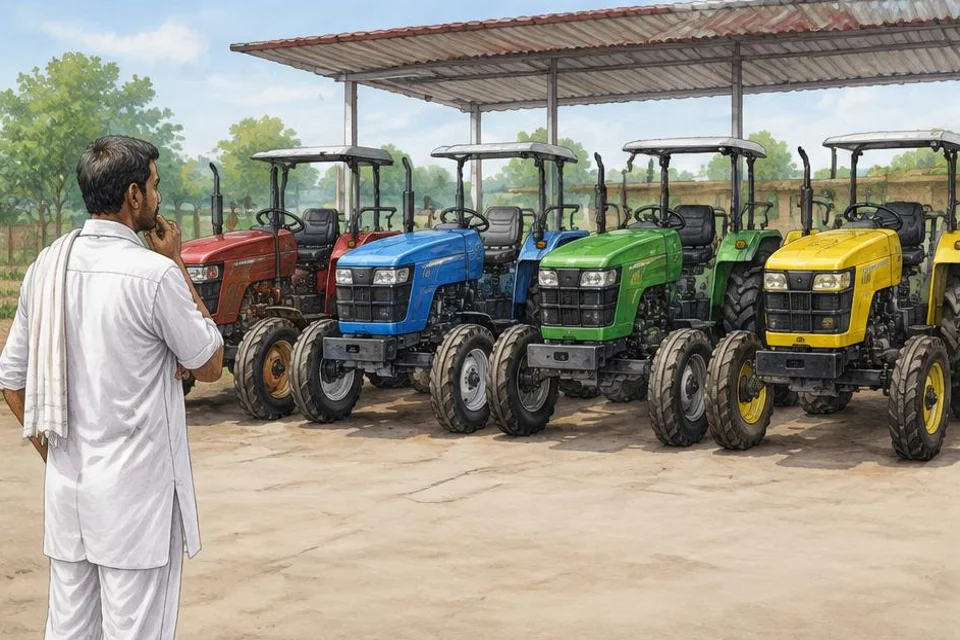
AI-generated illustration · Not a specific model photograph
Compare a shortlist, not brand reputations
Mahindra, Sonalika, John Deere and New Holland offer choices that should be judged against a farm’s work, not a universal ranking. Begin with your main operations, soil, slopes, access restrictions and existing implements. Then ask each dealer to propose an exact model and variant. A favourable experience with one tractor does not establish that every machine carrying the same badge suits another farm. Keep brand preference separate from the evidence needed for this purchase.
Build one specification sheet for everyone
Use current official product information and the quotation for the actual tractor offered. Record engine power, available PTO arrangements, transmission, drive configuration, tyres, linkage and hydraulic information using the manufacturers’ own definitions. Do not mix specifications from similarly named variants or assume an optional feature is standard. The official Sonalika and New Holland ranges illustrate why the model name alone may not settle the configuration. Ask the dealer to resolve missing or ambiguous information before comparing prices.
- Write the full model, variant and quoted configuration.
- Separate standard equipment from paid options.
- Mark unverified claims instead of filling gaps with guesses.
Test the implement combination fairly
Check each candidate against the same rotavator, mower, seeder or other intended tool. Mahindra’s rotavator tables identify engine-power ranges and implement characteristics, but these do not replace confirmation for the whole combination. Compare PTO speed, guarded shaft compatibility, linkage, weight handling and any hydraulic connections. Arrange similar demonstrations in representative conditions with trained operators. Never remove shields for a better view or adjust a running attachment; stop the engine and wait until all moving parts are stationary.
Assess handling and the operator’s workday
During a safe demonstration, consider access to the seat, visibility, steering effort, gear selection and control reach. Check whether useful operating speeds suit the actual task rather than counting gears alone. For orchard work, measure the complete tractor and attachment envelope; for transport, discuss the approved loading and braking arrangements. Do not interpret a short demonstration as a certified fuel-consumption test. Record conditions, workload and observations so differences in soil or operator technique are not mistaken for inherent brand advantages.
Compare local service and total cost
Ask each local workshop about routine parts availability, service arrangements and support during peak season. Request written warranty terms, exclusions and any conditions attached to maintenance. John Deere’s maintenance guide emphasises recurring checks and servicing; every shortlisted tractor also needs its own manual-based schedule. Compare delivered quotations with equivalent accessories, taxes and stated charges. Where finance is involved, compare the total repayable amount, fees, insurance conditions and repayment timing rather than judging affordability from the monthly instalment alone.
- List delivery, setup, training and included accessories.
- Request a written service and warranty explanation.
- Keep finance assumptions separate from cash quotations.
Use a scorecard and a clear decision rule
Set your priorities before scoring the demonstrations: implement fit, safe handling, local support and ownership cost are useful headings. Treat an essential safety or compatibility failure as a rejection, not a weakness that a discount can cancel. Ask for evidence where dealers make superiority claims, and leave unsupported statements out of the score. There is no universal brand winner or acreage-to-horsepower answer. Choose the documented configuration that meets your requirements and budget, and retain the quotation and agreed delivery checklist.