
Buying Guides
Choosing a Tractor for Orchards and Narrow Rows
Tractorbandhu Editorial · 29 October 2026
Measure your orchard, check the complete tractor–implement envelope, and arrange a realistic demonstration before buying.
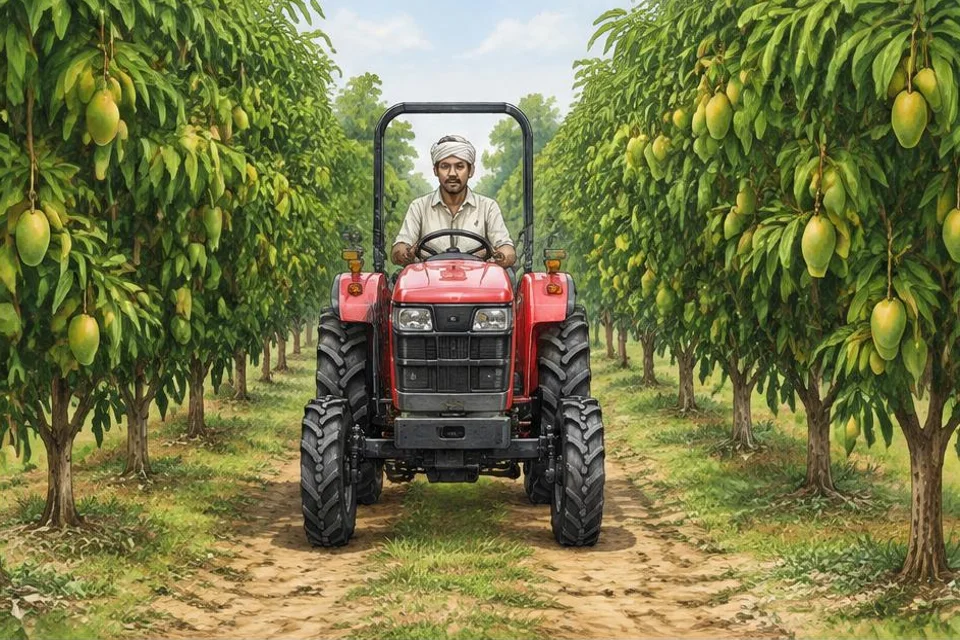
AI-generated illustration · Not a specific model photograph
Start with the orchard, not horsepower
An orchard tractor must travel between living trees without damaging trunks, branches, irrigation lines or fruit. Before visiting a dealer, sketch the actual routes used for spraying, mowing, cultivation and transport. Include access gates and the route back to the shed. Mahindra describes narrow width as an orchard feature, but that does not establish suitability for your particular planting layout. A compact appearance is only the beginning of a useful shortlist.
Measure the tightest working spaces
Measure usable clearance at several places, not simply the planting distance written in farm records. Mature trunks, low branches, guards around young trees and uneven ground can reduce the available corridor. Record the tightest headland and any drain crossings. Leave practical clearance for steering corrections and movement over rough surfaces; do not assume that a machine fitting through a stationary gap will work safely through it.
- Record the narrowest gate and row corridor.
- Note branch height, irrigation fittings and headland obstacles.
- Identify slopes, soft patches and restricted turning areas.
Check the whole machine envelope
Ask for the width of the exact tractor with the tyres and approved track setting being quoted. Then add the implement envelope: a mower, sprayer or rotary tiller may extend beyond the tyres. Consider rear overhang and sideways movement during turns. Mahindra’s Minivator tables distinguish working widths and other dimensions, illustrating why a tool’s nominal size is not enough. Have the dealer confirm compatibility in writing rather than relying on a photograph.
Match orchard jobs and ground conditions
List the implements you already own and the jobs that occupy most working hours. Check their PTO requirements, linkage, weight and hydraulic needs against the tractor manual. A sprayer changes handling as its tank contents change, so obtain the manufacturer’s loading and operating guidance. Discuss traction, approved ballast and tyre choices for your ground. Four-wheel drive can be a relevant option, but it does not make a slope safe or replace an operator’s terrain assessment.
Demonstrate turning and operator safety
Arrange a supervised demonstration in a representative row with the intended attachment, where safe and permitted. Observe entry, straight travel, headland turns and exit without using a tree as a clearance marker. Check visibility and comfortable access to controls. Do not remove protective structures simply to pass beneath branches; ask about an approved configuration and its operating instructions. Before any PTO connection or adjustment, stop the engine and wait until every moving part is stationary.
- Keep bystanders outside the demonstration area.
- Confirm guards and operator protection are present.
- Reject a setup that repeatedly forces contact or unsafe manoeuvres.
Buy a supported working combination
Compare complete packages rather than tractor prices alone. Include the matched implement, approved accessories, delivery, training and first-service arrangements in each written quotation. Ask how quickly the local workshop can obtain routine parts during the orchard’s busiest season. There is no universal acreage-to-horsepower rule for an orchard: row geometry, terrain, implements and workload all matter. Keep your measurements and demonstration notes, then choose the combination that meets those recorded requirements without avoidable compromises.