
Tractor Comparison
2WD vs 4WD Tractors: Costs, Traction and Uses
Tractorbandhu Editorial · 29 October 2026
Understand when extra driven wheels are useful, what they cost, and how to compare tractors under realistic conditions.
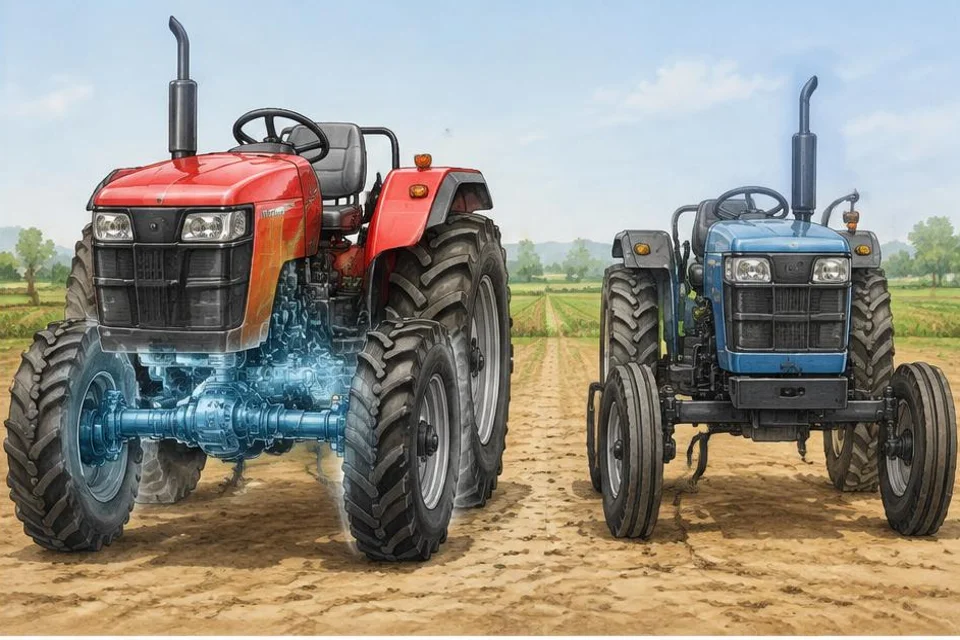
AI-generated illustration · Not a specific model photograph
1. Understand what changes with the drive system
By Tractorbandhu Editorial. In a conventional 2WD agricultural tractor, the rear wheels provide drive while the front wheels primarily steer. A 4WD or front-wheel-assist arrangement also sends drive to the front wheels. Mahindra’s comparison explains the traction advantage and the extra drivetrain complexity. This is not the same as increasing engine horsepower or PTO output. John Deere’s 5105 is offered in both 2WD and 4WD within the same 40 HP segment, illustrating why drive type and engine rating should be compared as separate specifications.
2. Identify where traction actually limits your work
List the operations in which wheel slip, soft ground or uneven conditions repeatedly interrupt progress. Four driven wheels can make more of the available power useful at the ground when traction is limiting. However, they cannot make every wet field workable or prevent getting stuck. Assess whether the soil can support machinery without unacceptable rutting or damage. For predominantly firm, level-ground work with appropriately matched implements, a 2WD candidate may meet the need. Do not pay for a traction solution before identifying a real traction problem.
3. Match uses without overlooking other limits
Evaluate 4WD for recurring soft-ground work or demanding pulling applications, then verify the exact tractor and implement combination. Check approved tyres, ballast, hitch limits and hydraulic requirements with the dealer. For transport, drive type does not override trailer capacity, braking requirements or safe speed. For orchard work, compare actual turning clearance rather than assuming every 2WD tractor turns tighter than every 4WD model. Four-wheel drive does not provide rollover immunity; slopes, edges, loads and operator behaviour remain critical. Do not use a demonstration to explore unsafe terrain limits.
4. Compare the whole cost, not a fixed premium
Obtain written quotations for equivalent engine class and equipment, clearly showing tyres, accessories and the drive variant. A 4WD arrangement adds front-drive components, which may increase purchase and repair exposure; ask for the model-specific maintenance schedule rather than assuming a universal service interval. Include finance charges, insurance, tyres, lubrication, servicing and downtime in the calculation. There is no reliable single rupee premium for all tractors and locations. A cheaper machine is not automatically economical if it repeatedly cannot complete essential work within the available season.
5. Measure fuel and output on a comparable job
Avoid universal claims that 4WD always saves fuel or always consumes more per completed job. Additional components and weight affect operation, while reduced wheel slip can improve progress where grip is limiting. Ask for supervised trials with compatible implements, similar soil conditions, comparable working depth and a fair tyre and ballast setup. Record time, fuel measurement method and finished area or task. Compare the quality of work too. A brief unloaded drive on a dealer’s yard cannot establish field productivity, seasonal savings or the payback period for the drive premium.
6. Learn the operating rules before deciding
Ask the dealer to explain when and how the exact model permits front-drive engagement and disengagement, including restrictions on firm surfaces and during turns. Follow the operator’s manual; do not transfer another tractor’s procedure to yours. Before checking tyres, drivetrain or attachments, park securely and stop the engine. For implement work, safely lower equipment, disengage and isolate PTO, remove the key and wait for complete standstill; retain all shields. Choose 2WD or 4WD according to documented work needs, affordable ownership and verified operation—not a promise of universal superiority.